
Liberty Parole Versus Probation
Parole and mandatory supervision belong to the state-sentence system. The Texas Board of Pardons and Paroles makes release decisions. TDCJ Parole Division processes an approved release and supervises the person in the community through district offices. Probation is imposed by a sentencing court instead of prison release and is supervised by Liberty County Community Supervision and Corrections Department.
| Feature | Parole or mandatory supervision | Probation/community supervision |
|---|---|---|
| Starting authority | Texas Board process and TDCJ release | Sentencing court order |
| Supervising agency | TDCJ Parole Division | Liberty County CSCD |
| Local office | Dayton District Parole Office | Liberty or Cleveland CSCD office |
| Original release proof | TDCJ incarceration and release history | Sheriff release record plus court order when jailed |
A probation record does not prove prior TDCJ incarceration. Active parole does not provide the minute a Liberty County Jail booking ended. Keep the court, jail, Board, and supervision records separate.
Verify Liberty Post-Release Supervision
Begin with the source of the sentence. A TDCJ number, prison unit, or Board review points toward parole. A Liberty court order granting community supervision points toward probation. When the source is uncertain, read the actual judgment rather than relying on a casual label.
- Match the identity with name, date of birth or age, agency number, and case information.
- For a current TDCJ prisoner, use the BPP status line for review, decision date, and next review.
- After favorable Board action, use Parole Division release processing to verify the prison transition.
- Contact the Dayton DPO to confirm an active Liberty County parole or mandatory-supervision assignment.
- For probation, read the sentencing order and contact the applicable Liberty County CSCD office.
- Use the Sheriff release record when the exact county-jail departure matters.
Liberty Parole Agency Roles
The Board, Parole Division, and district office perform different roles. The Texas Board of Pardons and Paroles decides parole and mandatory-supervision matters. Its status line at 844-512-0461 can report whether a current prisoner is in review, the last decision and date, and the next scheduled review. Public final decisions or panel minutes may be requested from BPP Public Information.
TDCJ Parole Division handles release processing after favorable action and supervises people after release. Its release-processing number is 512-406-5202. The Dayton DPO is the assigned local field office for Liberty County. It can verify a current supervision assignment but is not the custodian of an old county jail booking.
204 FM 686
Dayton, TX 77535
936-258-3892
Fax: 936-258-5346
The official Region III directory shown below confirms the Dayton office details.
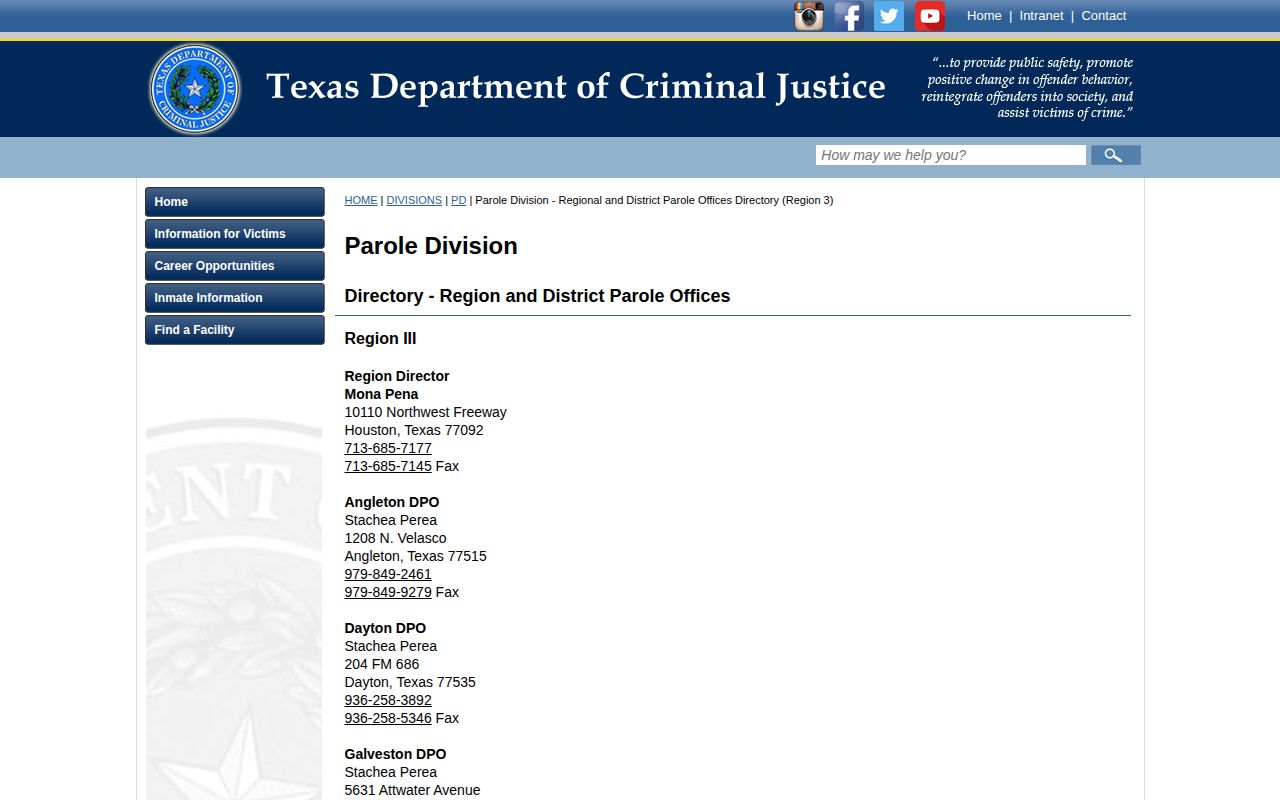
The directory connects Liberty County parole cases to Dayton. It does not show person-specific supervision status.
Liberty County Probation Offices
The Liberty County CSCD administers adult community supervision ordered by local courts. Contact the office assigned in the case to verify whether supervision is active, transferred, completed, or subject to a pending court action. The sentencing court remains the source for the judgment and conditions.
418 Main
Liberty, TX 77575
936-336-4553
Weekdays, 8:00 a.m.-5:00 p.m.
304A Campbell
Cleveland, TX 77327
281-593-8433
Weekdays, 8:00 a.m.-5:00 p.m.
Probation may begin without a state prison stay. If the person was held at Liberty County Jail before the court order, obtain the Sheriff record for the actual jail departure. The court order explains the supervision authority but may not contain the physical exit time.
Liberty Parole Decision Codes
Board vote codes describe decisions, not gate events. FI is favorable parole action, and variants can add a program, transfer, or future-month condition. NR means no release and another review date. SA means serve all. RMS approves release to mandatory supervision, while DMS denies mandatory supervision.
Eligibility under Texas Government Code Section 508.145 means the case may be considered under the applicable offense and date rules. It is not a grant. Section 508.149 contains mandatory-supervision exclusions and discretionary review provisions. After a favorable action, release-plan approval and processing may still remain. Confirm departure through Parole Division and TDCJ history.
- Parole
- Conditional supervised release authorized through the Board process.
- Probation
- Court-ordered community supervision administered by local CSCD.
- Mandatory supervision
- A statutory supervised release path subject to eligibility and review.
- Discharge
- The formal end of a sentence or supervision term.
- Absconder
- A person reported as failing to maintain required supervision contact, within the source's defined scope.
Liberty Absconder Search Limits
The TDCJ Sex Offender Absconder Search covers only the category named by that system. It is not a list of every person missing from parole supervision. The DPS registry is also limited to people with a legal registration duty. Neither database is a general parole roster or proof of a prison release date.
LCSO does not publish a simple general warrant list on its current warrants page. It routes warrant checks by fax, mail, email, or in person with identifying information. A failed registry or web search must never become a statement that no warrant or violation exists. Contact the supervising agency and the court responsible for the case.
Conditions vary by the controlling order and supervision plan. A reported violation can lead to investigation, warrant action, a hearing, changed conditions, or revocation, but none should be assumed without a record. Use precise agency wording.
Four Liberty Prison Release Roles
Liberty County contains four TDCJ facilities with different functions. Oliver J. Bell is a male pre-release unit. Lucile Plane is a female prison with documented reentry planning. Dempsie Henley combines a female prison, treatment, and intermediate sanctions. L.V. Hightower is a male prison with specialized programs.
The shared geography can mislead searchers. A person at one of these units is in TDCJ custody, not Liberty County Jail custody. A Henley treatment completion may return someone to existing supervision rather than create an unconditional discharge. A Plane reentry program or Bell pre-release class is context, not an individual release record. Use TDCJ, BPP, Parole Division, IVSS, and the assigned office for state cases.
Property After Liberty Jail Release
Post-custody tasks may continue after supervision starts. The Sheriff jail page directs former detainees to the Jail Property Division for personal property and identifies the commissary clerk at 936-336-9395 ext. 2801 for personal-fund reimbursement. It does not publish pickup hours, so call before travel and ask what identification is required.
Liberty County also publishes dated unclaimed jail-commissary fund documents. Do not reproduce names or addresses from them. A former detainee should contact the Sheriff with the PID so staff can locate the correct account. Property or funds follow-up does not establish parole, probation, or the release date. Use the proper supervision record for that question.
Liberty Supervision Notifications
TDCJ prison notifications use the Integrated Victim Services System. IVSS can provide notices about parole eligibility, Board decisions, discharge dates, release, and bench-warrant moves. It can be reached at 800-848-4284 or victim.svc@tdcj.texas.gov. A notice should be preserved with its exact wording.
Texas VINELink is the Liberty County custody and criminal-case layer linked by the Sheriff. It may report a jail custody change, but it is not the primary TDCJ prison notification service. Neither system substitutes for the final agency record. The Liberty County released inmate search shows how to pair a notification with the release and court records.
An IVSS notice about a Board decision should not be rewritten as a completed release. Likewise, a VINE event tied to Liberty County Jail does not establish active parole or probation. Match the agency, event type, and date before contacting the Dayton DPO or CSCD. That sequence prevents a custody alert from being mistaken for a supervision record.
Ending Liberty County Supervision
Supervision ends through the authority that imposed or administers it. TDCJ and Parole Division records establish state parole or mandatory-supervision discharge. Liberty County CSCD and the sentencing court document probation completion, early termination when ordered, revocation, or other case action.
Do not use “discharged” merely because reporting stopped or an online search failed. Request the existing closing or discharge record and match its date to the correct case. Expunction and nondisclosure are separate Texas court processes; they are not automatic consequences of completing supervision and should not be promised from a release or discharge alone.
A state case may need more than one closing record. TDCJ incarceration history can identify the prison release, while Parole Division records establish whether supervision later ended. The Dayton DPO can address an active local assignment but should not be treated as the source of a Board decision or the original prison departure. For probation, the Liberty or Cleveland CSCD office can verify its own supervision record, while the sentencing court supplies the order that created, changed, revoked, or ended the term.
Date labels also matter. A Board decision date, prison release date, supervision start date, and discharge date can all differ without conflict. The same is true for a probation order and a prior county-jail exit. When an exact date is important, name the event and source instead of merging the timeline into one generic release. If agencies report different facts, ask the record custodian to explain or correct the discrepancy.