
Liberty County VINELink Coverage
The Liberty County Sheriff's Office links Texas VINELink from its own site. That direct adoption matters. It makes VINE an agency-connected search and notification layer for the county custody or criminal-case context, rather than a generic service mentioned without local support.
VINE stands for Victim Information and Notification Everyday. VINELink is the public web interface used to search participating records and register for alerts. A matched Liberty record may report an agency-provided custody status or event. If the wording says released or out of custody, repeat that wording narrowly and corroborate it. Do not infer an exact release date unless the result displays one.
The county layer has limits. A transfer from Liberty County Jail can end the local booking without ending confinement. TDCJ prison events use IVSS. BOP, USMS, and ICE matters require federal sources. VINE is therefore one branch of a custody check, not a universal record of every release.
Search a Liberty VINE Record
Begin with identifiers that belong to the person being checked. Names can produce multiple matches. The agency and record association help distinguish a Liberty County booking from a similarly named person elsewhere in Texas. Avoid copying unrelated personal details simply to document the interface.
- Open Texas VINELink and use the person-search option.
- Enter the person's name or available offender identifier. Use the most accurate spelling known.
- Review possible matches and choose the record tied to Liberty County or the appropriate participating agency.
- Compare the identifiers shown. Do not select a record based on name alone when several results appear.
- Record the exact agency-reported custody wording and the time it was viewed.
- Corroborate a release event through LCSO Records and the Liberty court case.
A no-result is also limited. It may reflect spelling, agency coverage, a changed record, or another custodian. It does not establish release. Return to the Sheriff's jail page, check the correct court, and follow any known destination.
Texas VINELink Search Interface
The manifest includes a successful capture of the official Texas search interface. It demonstrates the statewide entry point without exposing a real person's notification destinations or sensitive record details.
Open the official Texas VINELink search.
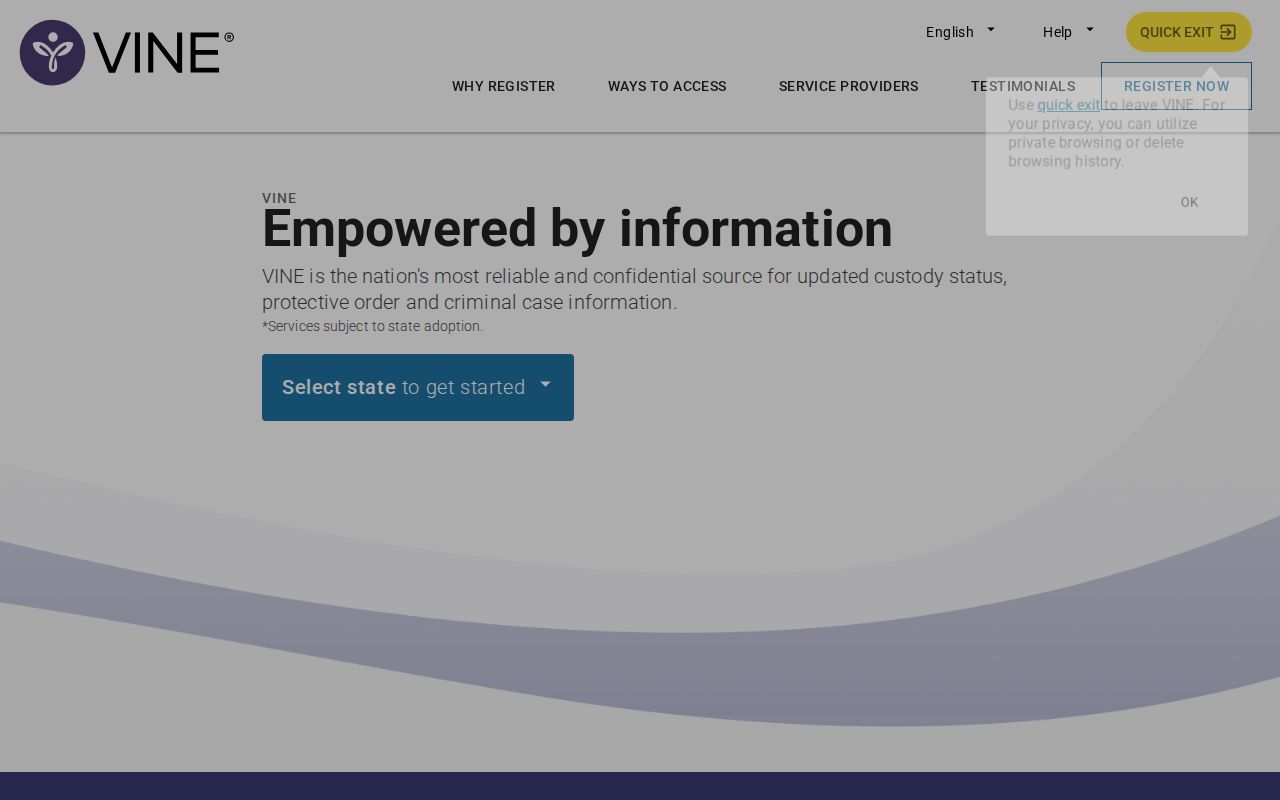
The interface is used to locate and match a participating record. What appears after selection depends on the agency data, so fields not preserved in research are not promised here.
| Item to check | How to read it |
|---|---|
| Person name or identifier | Use it to distinguish the intended record from another match. |
| Participating agency | Confirms whether the record belongs to Liberty County or a different custodian. |
| Custody wording | Repeat the displayed status precisely; do not translate it into “free.” |
| Notification option | Registers contact information for supported future custody events. |
| Event information | Use as an agency-reported signal, then verify through the custodian. |
Register Liberty County Release Alerts
Registration begins from the matched in-custody record. Verify the match before providing contact information. Texas instructions support phone and email options. Multiple contacts may be registered, which can help when more than one person needs the same agency event notice.
- Select notification registration from the correct record.
- Choose the supported phone or email contact method.
- Enter the requested contact information carefully.
- Create the memorable four-digit PIN used for phone alerts.
- Complete the confirmation steps shown by VINELink.
- When an automated call arrives, listen and enter the PIN followed by the pound sign to acknowledge it.
The Texas Attorney General brochure says unacknowledged calls can repeat for up to 48 hours. The PIN confirms receipt; it is not an offender identifier. For operator help, call 877-894-8463 and press 0. Never publish a person's alert destinations or PIN.
Registration should remain attached to the matched in-custody record. If several Liberty or Texas results share a name, compare the agency and identifiers before choosing one. An alert created on the wrong record can produce a real notification about the wrong person. Multiple contacts may be registered, but each recipient should keep the acknowledgment PIN private and update obsolete contact details through the service.
A phone call that repeats does not prove a second custody event. Under the Texas brochure's workflow, repetition can mean the first call was not acknowledged with the PIN and pound sign. Record the message wording and contact the operator when the alert cannot be matched. Then verify the event through LCSO rather than converting the call itself into a release time or destination.
Liberty County VINE Confirmation
The Sheriff's direct VINELink route is preserved in a successful manifest capture. It supports the local connection between Liberty County and Texas VINE.
View the Liberty County Sheriff's official VINELink route.
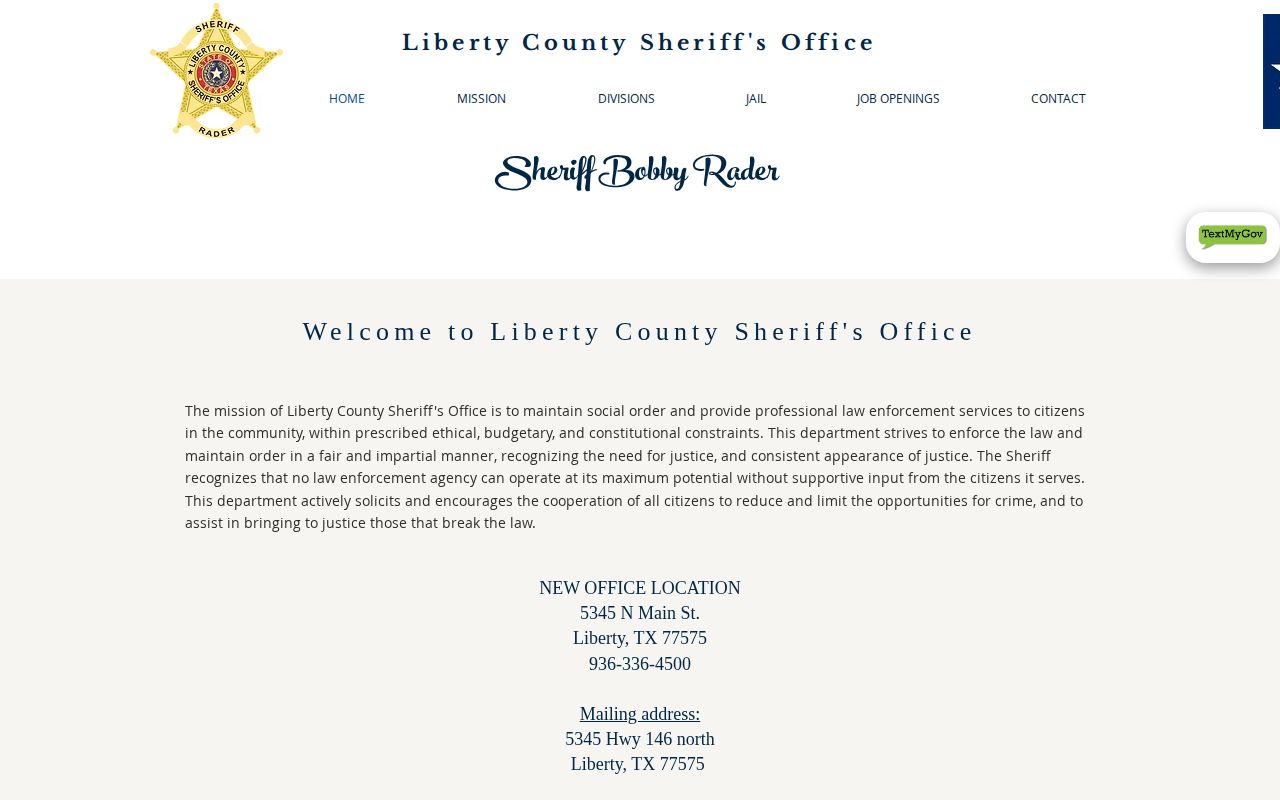
The capture establishes local adoption. It does not turn VINELink into the Sheriff's release record or prove a specific person reached the community.
After an alert, ask LCSO Records for the existing custody or release record. Useful details include the booking identity, end time, authority or type, and destination if the person transferred. Then read the matching court order or judgment. Court events explain legal authority, but the Sheriff's record is stronger for the actual end of county custody.
Liberty VINE Result Meanings
A status must be tied to its source and jurisdiction. “Released” on a participating Liberty record supports a reported county custody change. It does not establish dismissal, innocence, completion of every sentence, or absence of another hold. “In custody” means the selected agency reports custody at that point; it does not provide a guaranteed future release time.
- Agency-reported status
- The custody wording supplied through the participating agency's VINE record.
- Release
- The named custody event ended, subject to the authority and destination in the source record.
- Transfer
- Control passed to another custodian rather than to the community.
- Detainer
- A request or hold connected to another authority that may affect departure.
- Discharge
- A sentence or supervision ended; it is not a synonym for every jail exit.
When sources appear to disagree, compare event types and timestamps. A bond posting, court order, VINE notification, transport, and completed release processing can occur at different times without contradiction. The goal is to label each event, not force one date to answer every question.
Liberty County to IVSS Handoff
Liberty County has four TDCJ facilities: Oliver J. Bell, Dempsie Henley, L.V. Hightower, and Lucile Plane. Their presence makes the county-to-state distinction unusually important. A prison may stand within county boundaries while its custody and release records remain entirely under TDCJ.
For state-prison notices, use the TDCJ Integrated Victim Services System. IVSS can cover state events such as Board decisions, discharge, release, and bench-warrant movement. A favorable Board decision can contain conditions and still require release planning and processing. It is not the physical release event.
Review why TDCJ prison notifications use IVSS.
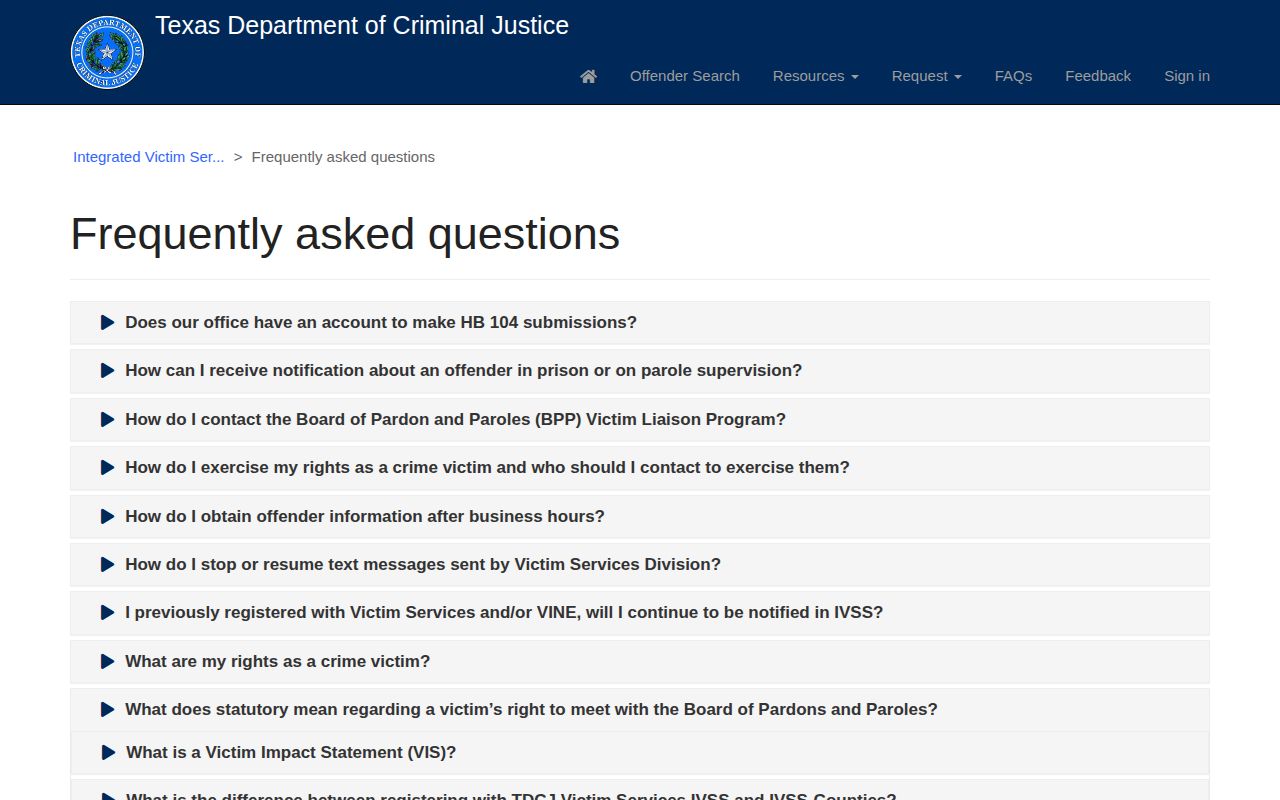
The official FAQ capture documents the state-prison notification channel. It helps prevent a county VINELink search from being stretched beyond its proper scope.
County VINE Versus State IVSS
Choose the channel by custodian, not by where the building sits. Liberty County Jail is operated by the Sheriff, while the four prison units are operated by TDCJ. A transfer can move a person's records from one layer to another.
| Situation | Primary notification or record path |
|---|---|
| Liberty County Jail booking | Texas VINELink, LCSO custody record, and Liberty court case |
| TDCJ prison custody | IVSS, TDCJ records, BPP, and Parole Division |
| Federal imprisonment | BOP locator and federal court record |
| Federal pretrial custody | Federal docket and USMS records |
| Immigration custody | ICE locator and the documented transfer destination |
The TDCJ online inmate search itself shows current incarceration information. Released people drop out of that online current-custody search, so absence does not establish parole, discharge, death, transfer, or date. Request incarceration and release history when historical confirmation is needed.
Liberty Court and Sheriff Checks
A VINE event should be paired with the office record and case record. Liberty's court search is divided by jurisdiction. Enterprise Justice excludes justice-of-the-peace cases, while district sources may route users through other services. Some images require clerk contact. Choose the clerk based on the identified case rather than assuming one universal docket.
A dismissal ends the charge shown in that case, but another case or warrant may remain. Bond authorizes release subject to conditions and holds, but does not supply the exact departure time. A judgment applying time served still does not prove processing was immediate. LCSO's release and destination record connects those legal events to the end of the actual booking.
For a precise conclusion, preserve the wording: the agency reported a custody change; the court filed a stated order; LCSO recorded the county booking's end. Each statement remains within what its source proves.
VINELink Safety and Data Limits
VINE data can lag or change, and Texas expressly warns against relying on it alone. If the event affects immediate personal safety, contact the responsible law-enforcement office and use an established safety plan. The service is a notification tool, not emergency dispatch or legal advice.
No official evidence makes VINELink a national locator. BOP and USMS events are federal. ICE has a separate locator with different identity inputs and limited recent-release coverage. The Texas DPS registry is also narrow: registry presence reflects a specific legal duty and is not a universal Liberty County release record.
- Match the person and agency before registering.
- Preserve exact status words and access time.
- Acknowledge phone calls with the private PIN.
- Confirm release through the custodian's record.
- Follow transfers through the receiving agency.
Note: Never publish a real person's notification contacts, PIN, residential address, or unrelated identifiers.
Public Record Search
Sponsored Results